Luftburnas hjälm-emblem
Luftburnas hjälm-emblem
Vilka luftburna hade spader, ruter, respektive klöver på hjälmarna? Jag har inte sett hjärter på någon.

Re: Luftburnas hjälm-emblem
Regementena ur 82.luftburna divisionen.Martin_ skrev:Vilka luftburna hade spader, ruter, respektive klöver på hjälmarna? Jag har inte sett hjärter på någon.

-
subskipper

- Medlem
- Inlägg: 1226
- Blev medlem: 23 mars 2002, 16:30
- Ort: Örebro (Äntligen hemma igen)
-
Von Nilsson
- Medlem
- Inlägg: 119
- Blev medlem: 26 juni 2003, 21:54
- Ort: Skutskär
-
subskipper
- Medlem
- Inlägg: 1226
- Blev medlem: 23 mars 2002, 16:30
- Ort: Örebro (Äntligen hemma igen)
PIR = Parachute Infantry RegimentVon Nilsson skrev:vad står PIR och GIR???Henric Edwards skrev:Ruter = 501st PIR (101. AB Div.)
Hjärter = 502nd PIR (101. AB Div.)
Spader = 506th PIR (101. AB Div.)
Klöver = 327th GIR (101. AB Div)
Så vitt jag vet använde inte 82. Flygburna den typen av hjälmstenciler.
~Henric Edwards

mavh//Von Nilsson
GIR = Glider Infantry Regiment
~Henric Edwards
Divisionen använde sig av "prickar" (tic var det englska uttrycket) i olika positioner vilken battalion de tillhörde. En "prick" i positionen kl. 12 symboliserade HQ, kl. 3 1st Bn, kl. 6 2nd Bn och kl. 9 3rd Bn.
Divisions Artilleriet ur 101st Airborne Division använde sig av en rundel, symboliserande en kanonkula. I divisions artilleriets fall symboliserade en "prick" kl. 12 HQ, kl. 3 321st Glider Field Artillery (GFA) Bn, kl. 6 377th Parachute Field Artillery (PFA), kl. 9 907th GFA Bn. Den 463 PFA Bn. som anslöts till divisionen strax innan Ardenneroffensiven hade 2 parallella "prickar" i kl. 6 positionen.
326th Airborne Engineeer Bn. ur 101st Airborne Division använde sig av ett stort E på sina hjälmar. I 326th Airborne Engineeer Bn. fall så symboliserade "prickarna" de olika kompanierna, HQ, A, B & C.
326th Airborne Medical Company ur 101st Airborne Division använde sig av ett Geneve Kors på sina hjälmar.
81st Airborne Anti-Aircraft and Antitank Bn. ur 101st Airborne Division använde sig av en uppåtvänd triangel på sina hjälmar.
101st Airborne Divisions musikkår hade en lyra målad på sina hjälmar.
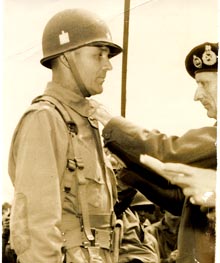
Bildtext: This photo of Max Taylor being decorated by Field Marshall Montgomery at Cherbourg in July, 1944 gives a good view of the 101st Division HQ stencil. U.S. Army photo.
/Mikael Sundholm
Divisions Artilleriet ur 101st Airborne Division använde sig av en rundel, symboliserande en kanonkula. I divisions artilleriets fall symboliserade en "prick" kl. 12 HQ, kl. 3 321st Glider Field Artillery (GFA) Bn, kl. 6 377th Parachute Field Artillery (PFA), kl. 9 907th GFA Bn. Den 463 PFA Bn. som anslöts till divisionen strax innan Ardenneroffensiven hade 2 parallella "prickar" i kl. 6 positionen.
326th Airborne Engineeer Bn. ur 101st Airborne Division använde sig av ett stort E på sina hjälmar. I 326th Airborne Engineeer Bn. fall så symboliserade "prickarna" de olika kompanierna, HQ, A, B & C.
326th Airborne Medical Company ur 101st Airborne Division använde sig av ett Geneve Kors på sina hjälmar.
81st Airborne Anti-Aircraft and Antitank Bn. ur 101st Airborne Division använde sig av en uppåtvänd triangel på sina hjälmar.
101st Airborne Divisions musikkår hade en lyra målad på sina hjälmar.
Bildtext: This photo of Max Taylor being decorated by Field Marshall Montgomery at Cherbourg in July, 1944 gives a good view of the 101st Division HQ stencil. U.S. Army photo.
/Mikael Sundholm
Senast redigerad av 2 Necros, redigerad totalt 16 gång.
Bifogar några bilder med de tidigare nämnda olika symbolerna.
Ruter:
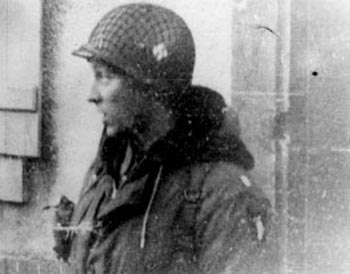
Bildtext: LTC George Griswold as commander of 3rd Bn 501 PIR in early 1945, wearing the diamond stencil with tic at 9 oclock.
Hjärter:
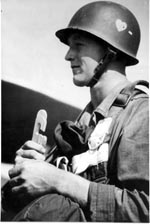
Bildtext: unknown member of C/502 awaiting the postwar 'pay jump' at Auxerre, France in 1945. As with all 1st battalion helmets, the 'tic' appears at the 3 o'clock position in relation to the regimental symbol.
Spader:
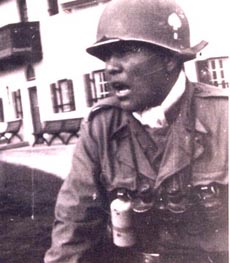
Bildtext: "Chief", a Native American member of D/506th wearing spades with a tic at the 6 oclock position for 2d Bn.
Klöver:
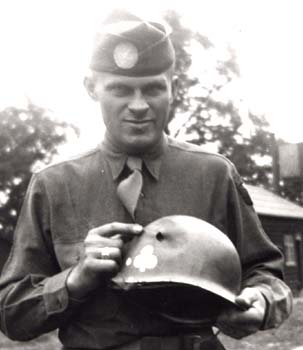
Bildtext: The symbol for the 327th Glider Infantry Regiment was a club (3-leaf clover). Ed Pieczatowski's helmet was shot off by a grenadier of the 17th SS division near Montmartin en Graignes, France, during the Normandy invasion. The bullet grazed Ed's skull and knocked him down. Here he is pointing to the evidence of his close escape from death, but we can also see the 327th stencil (Ed was in Company 'G').
Rundel:
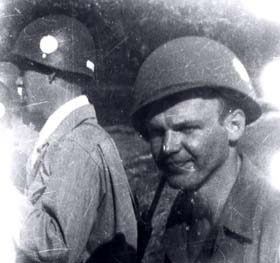
Bildtext: Members of the 377th Parachute Field Artillery Bn. wore the circular cannonball, with a tic at 6 o'clock.
E:
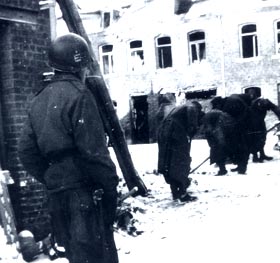
The 326th Airborne Engineeer Bn used a capital 'E' stencil. Because it was a battalion rather than a regiment, the 'tics' symbolized company, rather than battalion designations. The trooper shown guarding German PWs who are clearing rubble from the streets of Bastogne, is a member of HQ company, with a tic at 12 o'clock. A, B, and C companies had tics at 3 o'clock, 6 o'clock, and 9 o'clock, respectively.
Geneve korset:
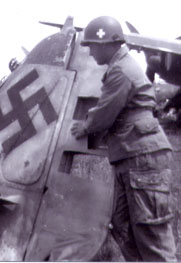
The medic standing at right, is Henry Hauser. He wears a helmet painted with the white Geneva Cross worn by the 326th Airborne Medical Company. He is inspecting the vertical stabilizer of a German fighter plane, which was abandoned along the autobahn in Bavaria, enroute to Berchtesgaden, in April, 1945.
Triangel:
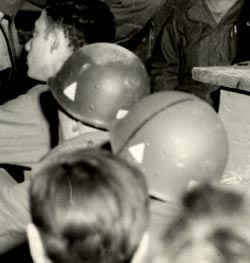
The 81st Airborne Anti-Aircraft and Antitank Bn wore a triangle
Lyra:
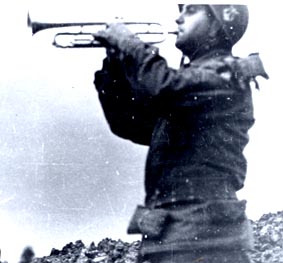
The 101st Division Band wore a 'Lyre'
/Mikael Sundholm
Ruter:
Bildtext: LTC George Griswold as commander of 3rd Bn 501 PIR in early 1945, wearing the diamond stencil with tic at 9 oclock.
Hjärter:
Bildtext: unknown member of C/502 awaiting the postwar 'pay jump' at Auxerre, France in 1945. As with all 1st battalion helmets, the 'tic' appears at the 3 o'clock position in relation to the regimental symbol.
Spader:
Bildtext: "Chief", a Native American member of D/506th wearing spades with a tic at the 6 oclock position for 2d Bn.
Klöver:
Bildtext: The symbol for the 327th Glider Infantry Regiment was a club (3-leaf clover). Ed Pieczatowski's helmet was shot off by a grenadier of the 17th SS division near Montmartin en Graignes, France, during the Normandy invasion. The bullet grazed Ed's skull and knocked him down. Here he is pointing to the evidence of his close escape from death, but we can also see the 327th stencil (Ed was in Company 'G').
Rundel:
Bildtext: Members of the 377th Parachute Field Artillery Bn. wore the circular cannonball, with a tic at 6 o'clock.
E:
The 326th Airborne Engineeer Bn used a capital 'E' stencil. Because it was a battalion rather than a regiment, the 'tics' symbolized company, rather than battalion designations. The trooper shown guarding German PWs who are clearing rubble from the streets of Bastogne, is a member of HQ company, with a tic at 12 o'clock. A, B, and C companies had tics at 3 o'clock, 6 o'clock, and 9 o'clock, respectively.
Geneve korset:
The medic standing at right, is Henry Hauser. He wears a helmet painted with the white Geneva Cross worn by the 326th Airborne Medical Company. He is inspecting the vertical stabilizer of a German fighter plane, which was abandoned along the autobahn in Bavaria, enroute to Berchtesgaden, in April, 1945.
Triangel:
The 81st Airborne Anti-Aircraft and Antitank Bn wore a triangle
Lyra:
The 101st Division Band wore a 'Lyre'
/Mikael Sundholm