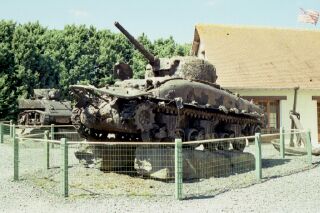
On 6 June 1944, a unit of 29 amphibious tanks launched from Allied ships to attack the Nazi-held Normandy beaches - only two made land. Brett Phaneuf went in search of those lost beneath the waves for almost 60 years.
...
The naval operation mounted on D-Day was without question the most massive in the history of war - but in the 53 years since the invasion no underwater archaeological research had been carried out.
Instead, the undersea record of that momentous event had been subjected to decades of erosion, and the clearing of any shipwreck which might prove a hazard to marine navigation.
Faced with the continued loss of this historical record, my Institute of Nautical Archaeology at Texas A&M University, in cooperation with Robert's Naval Historical Centre's Underwater Archaeology Branch, embarked upon the first archaeological reconnaissance of the area in the summer of 2000.
...
Soon innumerable magnetometer anomalies - deviations in the earth's magnetic field due to the presence of a massive, ferrous objects - were detected.
Perhaps most intriguing was a collection of vehicles assumed to be Sherman tanks, located at a considerable distance offshore at Omaha Beach.
We assumed these were most likely the remnants of a unit of ill-fated amphibious tanks assigned to support the US infantry in the first wave of the invasion.
These so-called Duplex Drive tanks of the 741st Armoured Battalion were launched from landing craft four kilometres from the beach. Fitted with large canvas skirts round the upper portion of the vehicle, the DD tanks were designed to float low in the water - appearing to the enemy as nothing more menacing than a rubber boat.
The entry of this first group into the rough seas proved disastrous. The tanks were intended to operate in seas with a one-foot swell, yet on D-Day the waves rose six feet.
The heavy seas swamped 27 DDs, sending them to the sea floor.
...
It seems as if the tanks were sent into the sea 6,000 yards out, as planned, but in a decision which didn't take the conditions into consideration.
Furthermore, the landing craft carrying them were drifting away from the target beach - forcing the tanks to set a course which put them side-on to high waves, thus increasing the amount of water splashing over and crumpling their canvas skirts.
Two tanks - skippered by men with enough peacetime sailing experience to know not to turn their sides to the waves - actually made it the beach.
It had been widely believed the other tanks sunk almost immediately on leaving the landing craft, but our work showed some had struggled to within 1,000 metres of dry land.
In fact some of the sinking tanks had had time to radio following units with a warning not to launch so far out - undoubtedly saving both lives and tanks vital to the battle.
Given the conditions on D-Day and the clumsiness of the tanks it is little wonder that the 741st met the fate it did, but that they launched at all is a testament to the courage and determination of Allied troops in the face of daunting odds and grave danger.
http://news.bbc.co.uk/hi/english/uk/new ... 016280.stm