
Sandbortsprutare vid övergången av kanalen 73?
MVH
Hans
Quiz: Pansarhistoria
-
Femtiotrean
- Medlem
- Inlägg: 5991
- Blev medlem: 6 december 2011, 15:33
Re: Quiz: Pansarhistoria
https://en.wikipedia.org/wiki/Bar_Lev_Line#BreachDuring the Yom Kippur War, the Egyptian army, led by Chief of staff Saad El Shazly, overran the Bar Lev Line in less than two hours due to the element of surprise and overwhelming firepower. To deal with the massive earthen ramparts, the Egyptians used water cannons fashioned from hoses attached to dredging pumps in the canal. Other methods involving explosives, artillery, and bulldozers were too costly in time and required nearly ideal working conditions.
In 1971, a young Egyptian officer, Baki Zaki Yousef, suggested a small, light, petrol-fueled pump as the answer to the crossing dilemma. The Egyptian military purchased 300 British-made pumps, five of which could blast 1,500 cubic meters of sand in three hours. In 1972, it acquired 150 more powerful German pumps driven by small gas turbines. A combination of two German or three British pumps would cut the breaching time down to two hours. These cannons pumped out powerful jets of water, creating 81 breaches in the line and removing three million cubic metres of packed dirt on the first day of the war.
Within the first hour of the war, the Egyptian engineering corps tackled the sand barrier. Seventy engineer groups, each one responsible for opening a single passage, worked from wooden boats. With hoses attached to water pumps, they began attacking the sand obstacle.
Many breaches occurred within two to three hours of the start of operations—according to schedule; however, engineers at several places experienced unexpected problems. The sand from the breached openings in the barrier was reduced to mud, which was one meter deep in some areas. This problem required that the engineers emplace floors of wood, rails, stone, sandbags, steel plates, or metal nets for the passage of heavy vehicles.
The Third Army, in particular, had difficulty in its sector. There, the clay proved resistant to high-water pressure and, consequently, the engineers experienced delays in their breaching. Engineers in the Second Army completed the erection of their bridges and ferries within nine hours, whereas the Third Army needed more than sixteen hours
https://eabbas.com/2018/04/03/in-egypt- ... -thinking/
Re: Quiz: Pansarhistoria
Helt rätt.
Hans och femtiotrean får slåss om frågan.
Hans och femtiotrean får slåss om frågan.
Re: Quiz: Pansarhistoria
Med det utförliga svaret tycker jag att 53'an förtjänar frågan. Tack för det.
MVH
Hans
MVH
Hans
-
Femtiotrean
- Medlem
- Inlägg: 5991
- Blev medlem: 6 december 2011, 15:33
Re: Quiz: Pansarhistoria
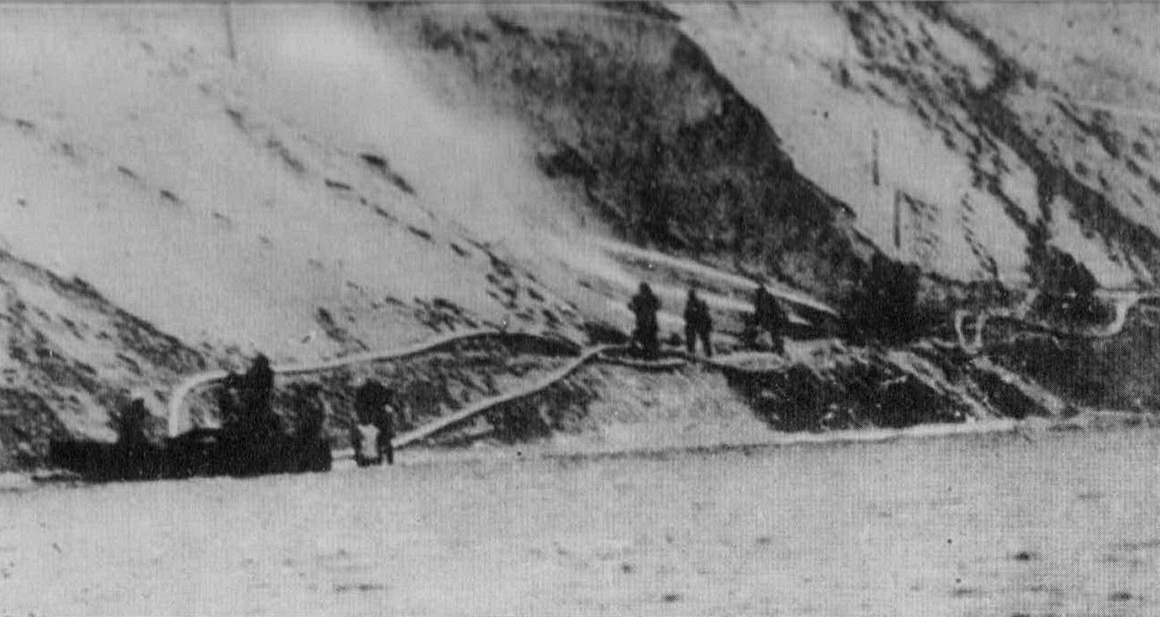
Hur kunde de egyptiska pionjärerna husera fritt i timtal? Var israeliska granatkastare utslagna av artilleri?
Jag tycket det var vekt av masase! Antagligen har han inte gjort lumpen?

Det råder ingen tvekan om att det är stridvagnshinder vi ser - men var befinner vi oss?
Re: Quiz: Pansarhistoria
Aldrig sett den typen tidigare, Albanien?
MVH
Hans
MVH
Hans

Re: Quiz: Pansarhistoria
Italien. Hindren ingår i den befästningslinje som Mussolini lät bygga innan han blev kompis med Adolf.
-
sveahk

- Redaktör och stödjande medlem 2026
- Inlägg: 12320
- Blev medlem: 3 februari 2005, 15:28
- Ort: Klockrike
Re: Quiz: Pansarhistoria
Italienarna byggde faktiskt hemligt vidare på vissa ställen fram till början av 1943!
Hans K
Hans K
-
Femtiotrean
- Medlem
- Inlägg: 5991
- Blev medlem: 6 december 2011, 15:33
Re: Quiz: Pansarhistoria
The barrier has a unique feature of its kind, in fact it has a very special anti-tank obstacle, in the shape of "dragon's teeth". This particular obstacle was built in June of 1938 in a peat bog. In reality, from the Austrian side at the time there was no real road, but only a mule track. According to the Italian general staff, the latter could be adapted in a short time to make it passable even by armored vehicles, therefore the barrier was built in anticipation of the construction of a driveway. This solution, unique of its kind, gives a characteristic appearance to the entire barrier.
This anti-tank barrier is therefore made up of two types of obstacles that alternate according to the ground on which they rest: where there is a peat bog there are "dragon's teeth", while where there is solid ground the typical anti-tank ditch has been built. It is 120 cm thick at the base and 60 cm in its upper part; it is made with boulders and is 1.5 meters high. In this way the space made inaccessible often becomes 6 meters. In some areas of the Pian dei Morti it was not conceivable to build a ditch of this type due to the conformation of the land, which was marshy; the line of the typical moat was therefore interrupted in three points, building here some spikes called "denti di drago", "dragon's teeth", an ideal obstacle for such areas. The dragon's teeth were then arranged in three parallel lines and driven into the ground with the same principle as the stilt houses (piling on marshy ground). They have a truncated cone shape and consist of a central body (core) in wood, covered in concrete with a diameter of 50 cm at the base. The heights of the cones vary between 90 and 120 cm; the cones of different heights are arranged alternately. The concrete base is surmounted by a conical steel cap with a diameter of about 40 cm at the base, firmly anchored to the underlying wooden core.


Lo sbarramento di Pian dei Morti (in tedesco Sperre Plamort) è uno sbarramento difensivo che fa parte del "XIII Settore di Copertura Venosta", all'interno del Vallo alpino in Alto Adige.
https://de.wikipedia.org/wiki/Alpenwall ... 3%BCdtirolThe Vallo Alpino in Alto Adige (in German Alpenwall in Südtirol) is a complex system of fortifications erected by fascist Italy to defend the Italian borders from a possible invasion by Nazi Germany.
Reschenpasset ligger i den italienska provinsen Sydtyrolen, strax söder om gränsen till Österrike.
Lasse har frågan!
Re: Quiz: Pansarhistoria
Tackar. Linjen visades i ett program från Viasat helt nyligen.
Vi lämnar Italien och undrar något om den här stridsvagnen. Tillverkad i USA men monterad i ett annat land. Vilket?
Vi lämnar Italien och undrar något om den här stridsvagnen. Tillverkad i USA men monterad i ett annat land. Vilket?
- Bilagor
-
Re: Quiz: Pansarhistoria
M 24.
Lönnairap ombord?
Tack för info om italienska hinder.
MVH
Hans
Lönnairap ombord?
Tack för info om italienska hinder.
MVH
Hans
Re: Quiz: Pansarhistoria
Nog är det en M24 men i vilket land monterades just det här exemplaret? Och c:a nio andra.
Ingen Lönnairap ombord.
Ingen Lönnairap ombord.
Re: Quiz: Pansarhistoria
Just det här exemplaret lär ha hetat Mulhouse.
Re: Quiz: Pansarhistoria
Då måste det vara en grodotank.
MVH
Hans
MVH
Hans
Re: Quiz: Pansarhistoria
Ja, och i vilket land monterade froggies ihop tio stridsvagnar av modellen M24?